
Progressive Web Apps (PWAs) are reshaping how users interact with websites, offering the speed and functionality of native apps without requiring downloads. According to Statista, mobile internet usage accounts for over 60% of global web traffic in 2025, making fast and reliable mobile experiences a priority for businesses. PWAs combine the best features of websites and mobile applications, allowing users to access app-like functionality directly from their browsers whether they are online or offline. For companies in the U.S., PWAs have become a vital part of modern web development strategies due to their speed, offline capabilities, and cost-effectiveness.
In this blog, you will learn what Progressive Web Apps are, their key benefits, the essential components that make them work, and how they function in real-world scenarios.
PWAs are websites that look and feel like mobile apps but run directly in a browser.
Progressive web apps use standard web technologies such as HTML, CSS, and JavaScript, but with added capabilities that make them faster, more reliable, and accessible even without an internet connection.
PWAs combine the reach of the web with the engagement of mobile apps,
creating a seamless experience for users.
With features like push notifications, offline access, and the option to install them on a device’s home screen, PWAs give users an app-like experience without the need to visit an app store.
Businesses value them because they work across all devices, load quickly, and keep users engaged while being easier and more cost-effective to maintain than separate native apps.
You may also read: What Is Mobile App Localization
Understanding the advantages of Progressive Web Apps is essential for businesses aiming to enhance user experience while optimizing development efficiency. Below are eight key benefits that demonstrate why PWAs are becoming a preferred solution in mobile app development and modern web.
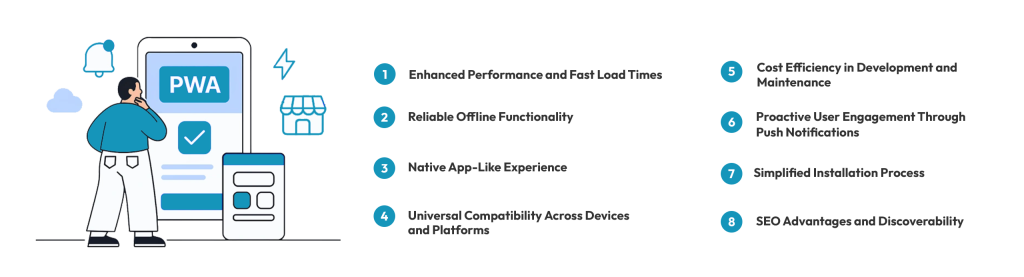
1. Enhanced Performance and Fast Load Times
Progressive Web Apps leverage service workers to cache critical resources, enabling near-instant loading and smooth performance. This ensures consistent user experiences even under variable network conditions, a crucial factor in retaining visitors and reducing bounce rates.
2. Reliable Offline Functionality
Through intelligent caching strategies, PWAs provide offline access to essential content and features. This capability ensures uninterrupted user engagement, particularly important in markets with inconsistent connectivity or mobile-first user bases.
3. Native App-Like Experience
PWAs deliver a seamless, app-like interface, including smooth animations, full-screen display, and intuitive navigation. This familiar experience drives higher user satisfaction and engagement without requiring users to download from app stores.
4. Universal Compatibility Across Devices and Platforms
Built on standard web technologies (HTML, CSS, JavaScript), PWAs function uniformly across desktops, tablets, and smartphones, regardless of operating system. This cross-platform compatibility reduces fragmentation and development complexity.
5. Cost Efficiency in Development and Maintenance
Maintaining a single codebase that serves all platforms significantly lowers development costs and accelerates time to market. Companies can allocate resources more effectively, focusing on innovation rather than maintaining multiple native applications.
6. Proactive User Engagement Through Push Notifications
PWAs support push notifications, enabling businesses to send personalized, timely updates that foster customer loyalty and increase retention rates. This direct communication channel enhances marketing effectiveness and user interaction.
7. Simplified Installation Process
Users can install PWAs directly from their browsers without navigating app stores, eliminating barriers such as lengthy approval processes and download friction. This ease of installation drives higher adoption rates.
8. SEO Advantages and Discoverability
Unlike traditional mobile apps, PWAs are fully indexable by search engines. This improves organic search visibility, allowing businesses to attract more traffic and expand their digital presence without compromising on user experience.
These benefits make Progressive Web Apps a compelling choice for businesses seeking to deliver high-performance, engaging, and cost-effective digital experiences across all devices.
You may also know: Latest Trends in Mobile Application Development
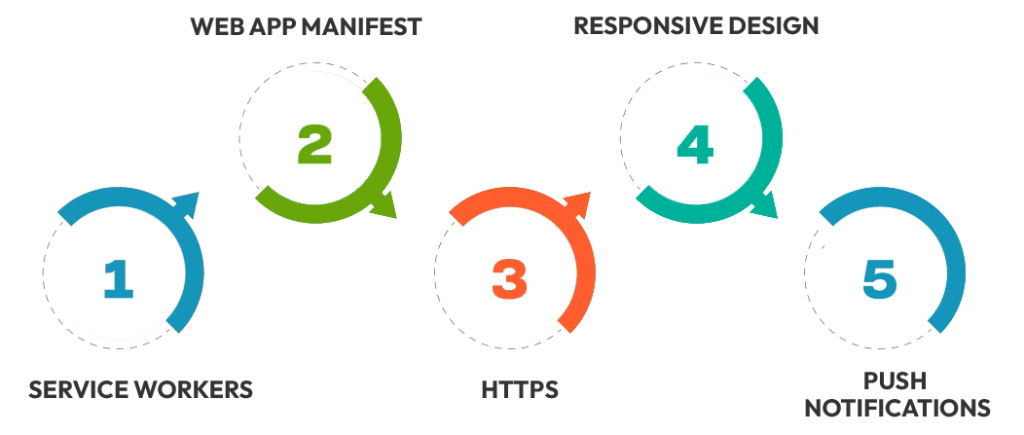
A Progressive Web App relies on several essential components that work together to deliver its fast, reliable, and engaging experience. Understanding these building blocks is key to developing PWAs that meet modern performance and usability standards.
| S. No. | Component | Description |
|---|---|---|
| 1 | Service Workers | Service workers are scripts that run in the background, independent of the web page. They handle crucial functions such as caching resources, enabling offline access, managing background data synchronization, and intercepting network requests to ensure smooth performance even with poor connectivity. |
| 2 | Web App Manifest | The web app manifest is a simple JSON file that provides metadata about the application. It defines how the app appears to users, including the app name, icons, theme colors, and display mode. This file enables users to install the PWA on their device’s home screen, giving it a native app feel. |
| 3 | HTTPS | Security is a fundamental requirement for PWAs. Serving content over HTTPS ensures encrypted communication between the server and the user, protecting data integrity and user privacy while meeting modern browser security standards. |
| 4 | Responsive Design | PWAs must deliver a consistent experience across all devices. Responsive design techniques ensure that the app adapts fluidly to different screen sizes and orientations, providing usability on smartphones, tablets, and desktops alike. |
| 5 | Push Notifications | Push notifications allow PWAs to actively engage users by sending timely, relevant updates even when the app is not open. This component helps businesses maintain ongoing communication and increase user retention. |
Together, these five essential components form the foundation of Progressive Web Apps, enabling businesses to deliver fast, secure, and engaging digital experiences across all devices.
You may also explore: 15 Essential Features for Effective Website Design
Progressive Web Apps (PWAs) operate by combining several web technologies to deliver an experience similar to native apps, but accessible through a browser. Here’s a detailed look at the core processes behind their functionality:
1. Initial Access and Setup
When a user first visits a PWA-enabled website, the app loads like any standard webpage. However, it quickly registers a background script called a Service Worker and downloads a configuration file known as the Web App Manifest. This manifest provides details like the app’s name, icons, and display preferences. The user is then offered the option to “install” the app, which simply adds a shortcut on their device’s home screen without a full app download.
2. Resource Caching for Speed and Offline Use
The Service Worker plays a central role by caching key assets including HTML files, style sheets, scripts, and images during the first visit. This cached content allows the app to load instantly on subsequent visits and to function even without an active internet connection, ensuring uninterrupted access for the user.
3. Network Request Management
Every time the user interacts with the PWA, the Service Worker intercepts network requests. It decides intelligently whether to deliver content from the cache or to fetch fresh data from the internet. This dynamic handling reduces load times and data usage while keeping the app content up to date.
4. Responsive and Adaptive Design
PWAs adjust their layout and user interface to fit the device’s screen size and orientation. Whether the user is on a smartphone, tablet, or desktop, the app provides a consistent and accessible experience, which is critical for usability and engagement.
5. Background Synchronization
When users perform actions offline like filling out forms or making changes, the PWA stores these actions locally. Once the device regains connectivity, the Service Worker synchronizes this data with the server automatically, ensuring user inputs are never lost and maintaining seamless operation.
6. User Engagement via Push Notifications
PWAs can send timely and relevant push notifications to users even when the app isn’t actively open. This feature keeps users engaged, delivers updates or reminders, and helps businesses maintain ongoing communication directly through the browser.
By combining these features, Progressive Web Apps deliver fast, reliable, and engaging experiences that work seamlessly across devices and network conditions, making them a valuable solution for businesses and users alike.
Let our web design and development experts create a high-performing site tailored for your business.
Progressive Web Apps offer businesses a fast, reliable, and cost-effective way to deliver app-like experiences across all devices. By combining key components like service workers and responsive design, PWAs ensure offline access, improved performance, and better user engagement. Understanding how PWAs work helps companies meet growing mobile demands while simplifying development and maintenance.
Share This Post
Would you like to transform your dream venture into reality?

Web development has undergone significant evolution in recent years. Traditional approaches, where content…

Running a business without a website is like keeping your doors closed when…

A clear understanding of what constitutes a hostile work environment helps both employees…

Transform your digital footprint & accelerate your business growth with InvoXico Technologies, a leading web development company
and your trusted partner for comprehensive digital marketing solutions.
 INDIA
INDIA


 USA
USA ©2018-2025 Invoxico Technologies. All rights reserved.